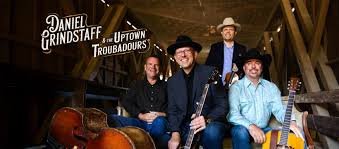
There’s a moment early on in Daniel Grindstaff & The Uptown Troubadours where everything clicks—the banjo snaps into place, the fiddle answers, the rhythm section locks, and you realize you’re not just hearing a collection of songs, but a band with real internal chemistry. That distinction matters. Plenty of Bluegrass albums boast pedigree; fewer feel this alive.
Grindstaff, a two-time IBMA-nominated banjoist with a long trail of Grand Ole Opry appearances behind him, has spent years proving his technical credibility. What’s more interesting here is how little he seems interested in showing off. His playing is sharp, undeniably, but it’s deployed in service of the song rather than as a spotlight grab. That restraint ends up being one of the album’s defining strengths.
The record pulls from a mix of new material and carefully chosen covers, and while that can sometimes create tonal drift, this set holds together remarkably well. Credit that, in part, to the Uptown Troubadours themselves—Kevin Richardson, Derek Deakins, and Kent Blanton—who bring a kind of unflashy precision that keeps everything grounded. Richardson’s vocals, especially, act as a stabilizing force throughout, whether he’s navigating the reflective “We See Love” or anchoring the more familiar melodic terrain of “Angel Dream.”
That latter track—Grindstaff’s Bluegrass take on Tom Petty—could have easily felt like a crowd-pleasing detour. Instead, it lands as one of the album’s most natural performances, stripped of rock polish and rebuilt with acoustic clarity. The same approach applies to “Danny’s Song,” which trades its soft-rock origins for something more intimate, almost conversational.
If there’s a thematic center to the album, it might be found in “We See Love,” a chart-topping single written by Rick Lang and Jim Grubbs. It’s a song that leans into ideas of faith and character, but what’s notable is how plainly it delivers them. There’s no grandstanding here—just a steady, heartfelt performance that lets the message breathe. In a genre that can sometimes overplay its emotional hand, that kind of understatement feels refreshing.
On the opposite end of the spectrum sits “Castlerock Turnpike,” an instrumental that gives Grindstaff and the band room to stretch out. Named in honor of Bluegrass legend Jimmy Martin, the track has a restless, forward-driving energy that never quite lets up. It’s not just fast—it’s purposeful, with each player pushing the momentum without tipping into chaos.
“The Death of John Henry,” featuring Marty Stuart, adds a different kind of gravity. The arrangement is deliberate, almost heavy, allowing the traditional narrative to unfold with a sense of inevitability. Stuart’s presence adds texture, but it’s the band’s discipline that keeps the track from becoming overwrought.
Elsewhere, songs like “Denver” (written by Larry Gatlin) and the gospel-leaning “A Little Goes A Long Way” expand the album’s emotional palette without breaking its cohesion. Even well-worn material like “Corrine, Corrina” is handled with a light touch, reinforcing the band’s commitment to feel over flash.
What ultimately sets this album apart isn’t innovation—it’s execution. Daniel Grindstaff & The Uptown Troubadours doesn’t try to redefine Bluegrass. It simply reminds you how compelling the genre can be when it’s played with this level of clarity, intention, and quiet confidence.
Claire Uebelacker