
“If I win, Toxaris, we shall go away together, with all that we need; but if I fall, bury me and go back to Scythia.” These were the last words of Sisinnes in the arena at Amastris. “I have lived long enough,” a poor young volunteer in another arena said to the friend he had replaced on the sand. Just two words in Latin (satis vixi), concise and powerful, but there was time for more: an explanation of why he was there, a last kiss through his visor, and a second valedictory. “By this my last glimpse of the light, by the celebrated sincerity of our love, do not let my father have to beg; sustain him, help him, give him your affection; if I merit it, be my substitute in caring for him.”
Article continues after advertisement
Of course, none of these words were actually spoken by gladiators. They were imagined by elite writers. Yet Rome was a culture that put a high value on last words, as well as brief, well-turned phrases delivered at moments of crisis. Julius Caesar was the master: “The die is cast,” when crossing the Rubicon; “And you, my child,” at seeing Brutus among the assassins. Gladiators were part of this culture, as we will see; they spoke laconic words, freighted with meaning, from beyond the grave.
Gladiatorial combat was not a wild scrum, like the melee in a medieval tourney. Two gladiators were matched in a duel. The pairings could be advertised in advance. At Pompeii the poster for the forthcoming show of Marcus Mesonius listed the names of each pair, their type of equipment, their victories, and noted those that came from one of the prestigious schools owned by the emperor. After the event, another hand added the results, a sign of the popularity of the Games. Other posters at Pompeii just give the number of different pairs that would be fighting. The matchups might be made on the day. We find Commodus making matches out on the sand, and Titus in the imperial box responding to the demands of the crowd. We have a hint that the crowd were often active in this regard.
When Commodus himself fought, sometimes it was an opponent he had challenged, sometimes one chosen by the spectators; “for in this,” Cassius Dio says, “he put himself on an equal footing with other gladiators.” Sometimes the pairings were decided by lot, although we imagine the biggest names would be held back for the finale. The emperor, or the giver of the Games with imperial permission, was in control of the day. Novelty was as appreciated in the running order and the pairings, as in every other aspect of the show.
The narrator in Pseudo-Quintilian’s fiction complains of the unfairness of the bout. The crowd pitied him. As a novice pitched against a veteran, there could be only one outcome—his death. Normally the palus ranking system prevented such mismatches. Seneca claims a gladiator thought it ignominious to be set against an inferior, “as he knows it is without glory to defeat an opponent without danger.” Although the observation of an outsider, it reflects a reality. Fighting those of a comparable or higher status brought greater prizes, advancement in the rankings, and more glory, perhaps even discharge from the gladiatorial school. If, of course, you won…
One type of gladiator, distinguished not by equipment but by sex, has attracted a lot of recent attention: women.
Gladiators, unlike beast fighters, were divided into very different types. There were those with “big shields” (scutarii), and those with small (parmularii). Joyless as ever, Marcus Aurelius was glad he had never been a fan of either. Within these broad categories there was a bewildering array of specific armaments. Painstaking modern research has identified the main types.
Some are well known today: the murmillo with his big crested and visored helmet, large rectangular shield and short sword, wearing a greave on his left leg; the Thraex, again with a visored and crested helmet (the latter often featuring a griffin), but carrying a small shield, curved sword, and with greaves on both legs; above all the Retiarius, without helmet or shield, wearing armor only on his left arm, and using a trident and net. Others are more obscure: the Hoplomachus, with a large, visored helmet, greaves on both legs, fighting with a spear and small, round shield; or the Eques, fighting on horseback, at least initially, wielding one or more javelins and a small, round shield.
The research proceeds by matching literary descriptions, less often archaeological artifacts, with visual images. Those images that have an inscription naming the type provide the starting point. Where there is no inscription, however, the methodology can lead to misplaced certainty. For instance, an image of a gladiator with a short, curved sword is always identified as a Thraex.
But this assumes that all Thracian gladiators always used such a sword, and that it was never used by any other type. Again, the Laquerarius, who was equipped with a lasso, is thought to have been identical to a Retiarius, except the latter had a net. Yet it is estimated that 90 percent of images identified as Retiarii do not depict a net. Some types mentioned in literary sources, such as the Dimachaerus, who fought with no shield and a sword in each hand, or the Manii, mentioned by a character in Petronius, have yet to be identified in the visual material.
The types of gladiators were not unchanging. The Samnites and Gauls of the Republic disappear from view under the principate, when the Retiarius emerges, along with the Murmillo and the Secutor. There is little to distinguish the last two; the only significant difference is the Secutor’s helmet, which had no plumed crest, and a visor with eyeholes, not a grille. Both might be descended from the Samnite. Gladiators varied across the empire. The Crupellarii, so encased in armor that they were almost invulnerable, were a specialty of the Gallic provinces, as were the mysterious Trinqui mentioned in the attempt of Marcus Aurelius to fix the price of gladiators.
To add to the difficulties of interpretation, equipment could vary within a type of gladiator. The Provocator, to us a lesser-known type, differed from a Murmillo mainly in having an armored plate that covered the upper part of his chest and a greave that extended up to the knee, which might imply a somewhat smaller shield. An inscription from Rome records a Provocator who fought with a spatha, a long cavalry sword, not the standard short gladius. Likewise diverging from the norm, a Retiarius on a pottery relief from Gaul, instead of being almost naked, wears a helmet, body armor, and greaves.
Finally, there is the issue of names of gladiators shifting from one type to another. A Secutor or Murmillo who fought a Retiarius was called a Contraretiarius. Perhaps the Manii in Petronius was a fan name for a type usually known by another designation?
While the broad outlines are fairly clear, dogma should be avoided when dealing with the various types of gladiators. The man giving the Games could alter the equipment of the com-batants for a specific occasion. Julius Caesar kitted out those appearing in his Games with silver weapons. Caligula, out of preference for their opponents the Thracians, made the fight more dangerous for the Murmillones by making their armor lighter.
One type of gladiator, distinguished not by equipment but by sex, has attracted a lot of recent attention: women. Mainly the interpretations are upbeat: although rare, they were not a novelty act but a serious contest; there was no prejudice against women fighting, just a social one against elite women in the arena; they were there to prove their courage (virtus); at the extreme, it is claimed some women entered the Games as an act of defiance, flouting gender expectations, to win “fame and glory.” Most of this sits rather uneasily with the evidence.
Part of the appeal of female gladiators was their very paradoxical nature.
Only one visual image of female gladiators survives, a relief sculpture from Halicarnassus. The two participants are named as Amazon and Achillia, the female form of Achilles; both are obviously stage names, and so neither are from an elite background (elites tended to use their real name; their status was part of the attraction). They are depicted fighting with the same equipment: large shields and short swords, their right arms protected by banded armor.
Yet, as often in Roman art, time is elided—the fight continues but it is also over. They have taken off their helmets and put them on the ground (these have no crests; are the women Provocatores, Secutores, or something else?). Above them the inscription records that the contest was a draw; both have been granted a reprieve. We do not know who commissioned the relief, or where it was displayed. It is not a tombstone. There are two plausible suggestions. Either it was part of a larger, public monument, erected by the giver of a show, recording a remarkable moment in his Games, or it was put up in the gladiatorial school to which Amazon and Achillia belonged, commemorating a remarkable event in the history of the familia. Whichever, it was remarkable in two ways. First, it was rare for both fighters to be released from the sands, stans missus. Second—remember that this monument is unique—it was remarkable that the combatants were female.
There are a few, scattered references to female gladiators. In AD 19 a law banned females of senatorial and equestrian families from appearing in the arena, which implies some had done so previously. We hear of women fighting as gladiators or beast hunters at imperial shows in Rome during the reigns of Nero, Titus, and Domitian. The historian Cassius Dio heaved a sigh of relief that those women who entered the arena under Titus were not from the elite.
Similarly, he approved when Septimius Severus forbade any woman, no matter what her origin, from fighting as a gladiator. As with many imperial laws, compliance may not have been absolute. On an inscription from Ostia, the port of Rome, that might postdate Severus’ enactment, a local magnate called Hostilianus boasted that he was the first to exhibit women fighting “since the founding of the city.” Given there had been half a millennium of gladiatorial combat, the proud boast—Ab Urbe Condita!—clearly indicates the extreme rarity of female gladiators.
Combat was highly gendered in Classical antiquity. Homer set the tone. In the Iliad Hector told his wife, “let war be the care of man.” Part of the appeal of female gladiators was their very paradoxical nature. For the poet Statius they illustrated the emperor’s command over human nature, geography, and the past: “The sex that is inexperienced and ignorant of steel stands like men in wicked combat; you would think them troupes of Thermodon in battle heat by the River Tanais or wild Phasis”; in other words, Amazons from the distant past who came from along the far shores of the Black Sea. For Martial they showed that the goddess Venus had joined the god Mars in serving Caesar.
There were other, less elevated, reasons to watch women on the sands. One was male titillation. Amazons traditionally went into battle with at least one breast exposed. Amazon and Achillia in Halicarnassus are topless, wearing only a loincloth. Christian moralists thundered against the sinful pleasures of watching naked female flesh at the Spectacles. For Saint John Chrysostom, it was the “shipwreck of the soul.” The pagan Martial enjoyed the sight.
A final, equally lowbrow, motive comes into view if we think about others with body shapes unusual in the arena. Dwarfs occasionally fought in the arena. It is a popular misconception that dwarfs fought women. Although the two were sometimes on the same bill, dwarfs took on each other or animals. In Statius a “bold string of midgets” appears after the Amazon-like women.
Female gladiators were so rare there was no name for them in Latin or Greek.
First, they dealt each other wounds and threatened death—mock-gladiatorial combat or boxing?—then they were attacked by cranes, thus acting out the mythical battle between the birds and Pygmies. How the audience laughed, the poet assures us. In paintings, Pygmies fight hippos and crocodiles in the Nile; some are shown being eaten. Not re-created in the arena—presumably too one-sided. Once in a while, a very bad emperor was said to have rounded up the disabled. Caligula selected respectable family men of good reputation, who were conspicuous for some physical disability, for a mock fight.
The result was far worse in the story we have already encountered of Commodus personally clubbing to death disabled men sewn into fish tails and armed with sponges. In art we find children, or Erotes, chubby toddlers with wings, fighting as gladiators or hunters in the arena, once even as condemned to the beasts. All were intended to be amusing.
A key attraction of watching female gladiators was the paradoxical spectacle of women displaying virtus, fighting with the courage of men. For some spectators, like Statius and Martial, it evoked the power of the emperor, and the empire, over nature, as well as over geography and time (Look at those Amazons from a far-flung place in the distant past!). But there were baser attractions: the pleasure of viewing half-naked women, sweating and panting, and the license for ribald humor and coarse laughter. The Romans did not share our sensibilities about gender or deformity. Like dwarfs and the disabled, female gladiators were considered funny.
But, unlike the disabled, they were transgressively sexy. Think about the responses of a Roman man viewing her—“She is really fucking him [in both English senses: literal and metaphorical]! Imagine her riding you like that! Imagine ‘conquering’ her; taking her in a more dominant position!” Unsurprisingly, there was a current of disapproval, a compound of the moral, political, and social. The higher the status of the women the stronger it ran. Eventually the disapproval won. Septimius Severus banned women from the arena. We hear of no more female gladiators after Hostilius’ show: perhaps Ostia only saw women in the arena once? Female gladiators were so rare there was no name for them in Latin or Greek. Gladiatrix is a modern invention. In the Roman empire they were a novelty act that provoked a wide range of responses.
__________________________________
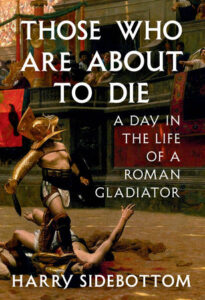
Excerpted from Those Who Are About to Die by Harry Sidebottom. Published by Alfred A. Knopf, a division of Penguin Random House LLC. Originally published in hardcover in Great Britain by Hutchinson Heinemann, an imprint of Penguin Random House UK, in 2025. Copyright © 2025 by Ballista Warrior of Rome Ltd.