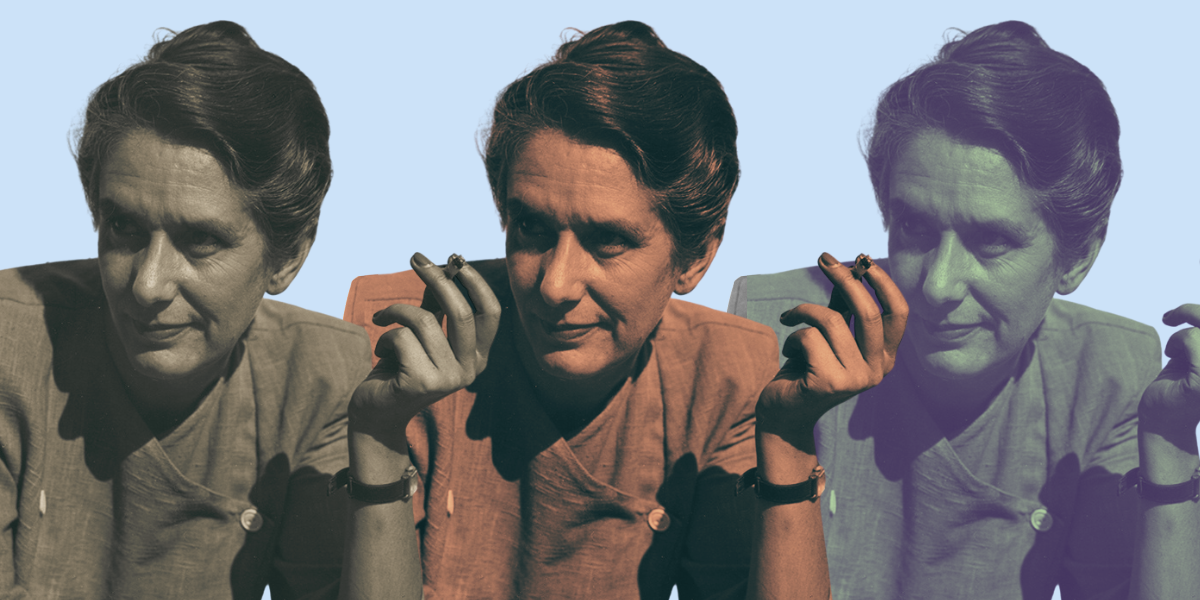
Erika Mann drove through the night to meet the fifty-two most wanted men in the world. It was the middle of August 1945 and she was a few weeks shy of her fortieth birthday. Streaks of gray were beginning to show in her short brown hair. She gripped the steering wheel with gloved hands, only raising them to light cigarette after cigarette, which she smoked out of the corner of her mouth. She was thin but far from frail in her signature attire of trousers and flat, practical shoes. As night swallowed up the road ahead, her dark eyes had a singular intensity of focus.
Article continues after advertisement
The previous afternoon in Paris, Mann had been commissioned by London’s Evening Standard to write a story that would start to make sense of over a decade of suffering. The eldest daughter of Nobel Prize–winning author Thomas Mann, Erika was a writer and performer of rare commitment. She had staged an anti-Nazi cabaret in Munich in 1933 and broadcast for the BBC since 1940. Mann was attached to the Allied forces from 1943 onward and accompanied them as they swept toward Germany. Even before that she was a veteran reporter of conflict, having gone to Spain in 1938 to cover the civil war for the New York–based German-language newspaper Neue Volks-Zeitung.
Could she face the monsters who had degraded her family and shattered her country?
Her qualifications for her current mission were not merely professional. Erika had been living in exile in Europe and the United States with her family since 1933, when they escaped Munich for the safety of Zurich in the wake of Hitler’s election as chancellor. The Manns were subsequently declared enemies of the state and in 1935 stripped of their German citizenship. Now she was finally in a position to confront and expose the men she had spent years denouncing.
In the blue predawn light, she made out a string of factories, blast furnaces, and workers’ barracks. She was now in Luxembourg. As the sun rose, she began to feel uneasy. She loved driving in the dark, sitting alone at the wheel, surrounded by her belongings. It brought her a feeling of “extreme cosiness and security.” But now the road was beginning to fill up with American jeeps and trucks. The air was getting warmer but she had begun to shiver as doubts about her assignment plagued her. Could she face the monsters who had degraded her family and shattered her country?
Erika’s destination was Mondorf-les-Bains, a Luxembourg spa town where the surviving leaders of the Nazi regime had been imprisoned in an old hotel. The long process of delivering justice to the authors of the most abhorrent chapters in human history had begun. The German-born, liberal, cosmopolitan, and progressive Erika Mann, whose family, country, and worldview had been blown apart by the prisoners, would be one of a handful of journalists and the only woman to enter the camp where they were interned. She would need all of her personal and journalistic determination to gain access to the imprisoned men. The man in charge of the prison camp, Colonel Burton C. Andrus of the US Army, was a flashy dresser with a neatly trimmed mustache and clipped speech, well known for relishing his position. Dissatisfied with her paperwork, he sent her on a further 300-mile round trip to obtain new documents in Frankfurt before she was able to embark on her assignment.
The Palace Hotel had been built, along with a new spa, in 1926 as part of a drive to restore Mondorf to its late nineteenth-century glory. The building was grand for a small spa town, with four stories and two wings built at angles, a balcony at every window, and a terrace overlooking flower gardens. Before the war it had been a refuge for those fleeing the Nazis, and during the war it had played host to Nazis seeking rest and relaxation. Now simple military cots replaced the luxurious beds, and fiberglass and iron bars fortified the windows. Sentries armed with machine guns looked down from newly constructed watchtowers, among fortifications thick with searchlights and strewn with barbed wire that rose to fifteen feet. Erika “circle[d] the premises” hoping to catch a “glimpse of its occupants,” but sheets of canvas had been hung from trees in the grounds to obscure the view, and strands of live electric wire were coiled atop the high fence.
The former Palace Hotel had been given a new moniker: Central Continental Prisoner of War Enclosure number 32, or, more memorably, “Camp Ashcan”—a counterpart to the British-run “Camp Dustbin” in Frankfurt where Nazi scientists, technicians, and administrators were detained. Its rooms had been filling up through the summer of 1945 with names notorious across the globe. As Erika commented in her unpublished memoir, “Alien Homeland,” “Germany’s big 52 were being held here, that crop of leading Nazi war criminals from which the Nuremberg prosecution was to pick its defendants.”
Though debates continued over exactly who should be in the dock at Nuremberg, some were sure to end up there. Wilhelm Keitel and Karl Dönitz were, respectively, chiefs of the Wehrmacht and Navy high commands. Hans Frank was governor general of occupied Poland. Fritz Sauckel and Robert Ley were both prominent in the institutions of Nazi slave labor, Sauckel as general plenipotentiary for Arbeitseinsatz (labor deployment) and Ley as head of the Deutsche Arbeitsfront (German Labor Front). Arthur Seyss-Inquart was the Reichskommissar of the occupied Netherlands and Joachim von Ribbentrop was the Reich minister of foreign affairs. Foremost among those captured alive, “prisoner number one,” was Hermann Göring.
To many outside Germany, Göring was known as commander of the Luftwaffe—the rank of Reichsmarschall had been specially devised for him—but his involvement in Nazi criminality went far deeper than that. Since 1938 he had been in charge of Nazi “Jewish policy,” and in July 1941, acting as Hitler’s second in command, he had instructed Reinhard Heydrich to implement the “Final Solution to the Jewish Question”—a plan for murdering all Jews in Europe.
Erika studied acting in Berlin, performing in Munich, Hamburg, and Bremen. It was the success of her anti-Nazi cabaret Die Pfeffermühle (The Peppermill ) that had prompted her flight from Germany to Switzerland in 1933. Now it was time to perfect her acting skills in order to conceal her fury at meeting men who had exiled her from her homeland and reduced Germany to a country she could no longer recognize:
No stage part that I had ever played seemed so treacherous as that of the aloof placid American lady journalist which I was about to embody…Would I be permitted to talk to them? To the monstrous Prisoners at the “Palace?”…Should I even apply for those interviews? Of course I would; I was still a reporter. But I hoped rather ardently that my request would be turned down. How could I possibly talk to those beings? How could I ask questions, cooly and in a civilized manner where the most violent, the most extreme accusations seemed lame and wholly inadequate?…Supposing even I were forced (“permitted,” I thought) to watch them in silence, would I be able to control myself? Would not the sickening disgust with which they filled me be mirrored in my face?
She was accompanied into the Ashcan by Colonel Andrus and a lieutenant colonel from the American battalion that staffed and guarded the camp. “No spookier adventure could be imagined,” she wrote to her mother, Katia Mann, describing the journey through the double stockade and into the prison camp hotel. There may have been a lightness of touch in her phrasing as she prepared to see “tout le horror monde locked up,” but the horror was powerfully, personally real to Erika. It would remain with her for life.
Andrus shared stories as he ushered her toward the prisoners’ living quarters. One man, he said, had claimed to be a regent and therefore required a necktie. Such potentially lethal articles of clothing were not allowed under any circumstances, no matter the prisoner’s real or imagined rank. For many coming to the Ashcan, suicide was regarded as the best—indeed the only—means of escape. Hitler, Goebbels, and Himmler had already taken that route to evade capture and punishment, so the example was in the prisoners’ minds. Andrus had found razor blades taped to the soles of feet, while cyanide had been discovered sewn into clothes and even, in the case of Göring, secreted in a tin of Nescafé. Hans Frank, dubbed “the Butcher of Poland” on account of having overseen at least 4 million murders within the occupied nation, had inflicted on himself four major wounds—at his throat, arm, wrist, and stomach. He survived—“allergic to suicide,” Erika dryly noted. A master in the art of delivering death, Frank had failed to accomplish his own.
Erika’s first sight of the captive Nazi high command came via a half-open door to their living room. She watched discreetly, observing “some twenty of them, reading aimlessly, writing, or doing nothing at all.” Although they were quiet, she detected a nervous energy. Dönitz and Walter Warlimont were both writing feverishly; Robert Ley, the former head of the German Labor Front, was composing his memoirs—perhaps with particular urgency, given that he would soon manage to hang himself. Others were composing letters to President Truman and General Eisenhower, protesting the cruelty of their fate.The men had been stripped of rank and insignia, and now wore unmarked uniforms, civilian dress, or fatigues stamped on the back with the initials PW (prisoner of war), a uniform that, Erika noticed, allowed some to delude themselves that they were “just another captured German” rather than a “major war criminal awaiting trial.” All the men had a five o’clock shadow as the barber made his rounds only every other day. There were no shoelaces in sight since they, like neckties, could be repurposed.
Erika’s accompanying guards waved her on. They turned for the bedrooms, which were shared. Here she observed more openly, exchanging glances with the prisoners. Hans Frank and Ribbentrop, the former minister of foreign affairs, were roommates in the first room she came to. Frank, who had seemingly given up on his bid for suicide, claimed to have had a number of visionary experiences and was in the process of converting to Catholicism. “The Butcher of Poland was reading the Bible to the ex–champagne salesman,” Erika wrote in the first of her Evening Standard pieces. To Erika the Ashcan did not seem like a prison at all, but rather “a veritable insane asylum.” In a letter to her mother she described the experience as a horror film: “It was an eerie experience to visit the spectacular inmates of the ‘big house.’”
When Erika came face to face with Hermann Göring, he was having breakfast in bed, a circumstance that made her smart. “He glanced at me silently,” she wrote, as had all the other men who noticed her observing them. Göring was receiving all his meals in bed, having been incapacitated after a forced withdrawal from an opioid addiction—first to morphine and then to paracodeine—that had lasted over two decades. He had suffered some sort of heart attack brought on by this withdrawal and been given the privilege of a proper mattress instead of a military cot.
The Allied authorities, from those running the camp to the prosecutors building a case in Nuremberg and beyond, wanted him healthy enough to face trial. In the piece she wrote for Liberty magazine, Erika was quick to mention the full detail of the ex-Reichsmarschall ’s addiction, as well as the fact that after losing thirty pounds he was “in better physical condition than he has been for years.” Like all the prisoners in the hotel, he received a monthly ration of “half lb of pipe tobacco, two bars of soap, half a tube of toothpaste, and four books of matches.”
When most of the Nazis received their rations they acted “like children at Christmas,” but Göring had initially complained: “‘My dog,’ Göring told the waiter, a German prisoner of war, ‘ate better.’ ‘Your dog,’ replied the waiter, ‘ate better than the German people.’” Erika noted a particularly disturbing aspect to his appearance. “His sunburned skin seems too wide for his figure and his greenish eyes, normally protruding, now bulge like those of a carp.”
She also noted his need to be superior to his surroundings and company, insisting on “wearing his chapeau during meals, just to be outstandingly dressed. Since you can’t kill yourself with your hat, as you can with your tie, Göring’s request was not considered excessive.” She wasn’t the only one who registered Göring’s evident estimation of himself as preeminent. The first psychiatrist to examine the Mondorf prisoners, Major Douglas Kelley of the US Army Medical Corps, remarked that Göring, though sane enough to go on trial, was an “acute narcissist.”
On October 20, 1943 the United Nations War Crimes Commission was established in London.
Erika’s visit occurred as the men were being prepared for transport to Nuremberg, which took place on August 12. Her piece for the Evening Standard appeared the following day. She was explicitly forbidden by the authorities from interviewing the imprisoned men, who had “proved only too anxious to plead their case without a jury for publication.”
However, she noted in the draft of her Evening Standard piece that Göring studied her curiously when their eyes met. She may not have been granted the opportunity to speak to them by the American forces in charge, but she did ask that the interrogators let the men know who she was after she had left. The reports she received pleased her enough to be included both in her article for Liberty and a letter to her mother. Her relish of her personal notoriety among the Nazis and the extent of Göring’s continuing self-delusion are both very evident:
Ley screamed: “Assez!,” covering his face with his hands; Rosenberg muttered: “Pfui Diable!” And Streicher lamented “Du Lieber Gott and to think that that woman has been in my room!” Göring was most excited. If only I had introduced myself, he said, he would have explained everything; and, had he been in charge of the Mann case, he would have handled it differently. Surely, a German of the stature of T[homas] M[ann] could have been adapted to the Third Reich.
What Erika did not include in her piece, nor in the letter to her mother, was that when Streicher—who was known for his extensive pornography collection—saw her, he laughed and exclaimed: “Ha! So you’ve come to gaze at all the wild beasts in the zoo!” and then dropped his trousers and exposed himself. Erika, in suit and tie, was unbothered. She flicked ash from the tip of her cigarillo, turned around, and walked to the next room.
As she left the Ashcan, the prisoners were packing up their meager belongings. The next stage of their collective fate had been sealed: thirty-seven were being sent to Dulag Luft, the infamous former Nazi interrogation camp northwest of Frankfurt, and fifteen were bound for Nuremberg. Erika watched the jeep-escorted convoy heading for the airport and noted that some of the fifteen prisoners had donned “gaudy hats adorned with Tirolese feathers.” The last time some of them had been in Nuremberg they were decked out not just in jaunty hats but in full Nazi paraphernalia and backed by the pomp of the propaganda machine. They had been triumphant, convinced that victory was theirs. Now they were defeated. Although they were set to return to their homeland, they were entering unknown territory.
From Mondorf, Erika headed to London, where crucial debates about the nature of the forthcoming prosecution were coming to a head after years of legal and diplomatic discussion. That there would be a trial at all was far from inevitable. As early as January 1942 the Free French government and eight other governments in exile had signed a declaration in London calling for the prosecution of war crimes, but at that point the British and Americans had withheld their explicit support. While the Soviets were keen advocates of a postwar legal process, Stalin had also proposed the mass execution of tens of thousands of German officers during the Tehran Conference in late 1943. A pivotal moment came slightly earlier that autumn, at the Moscow Conference of October 1943, when Franklin D. Roosevelt, Winston Churchill, Joseph Stalin, and Chinese foreign minister T. V. Soong issued a joint declaration on German atrocities. It proclaimed that
German officers and men and members of the Nazi Party who have been responsible for, or have taken a consenting part in the above atrocities, massacres and executions, will be sent back to the countries in which their abominable deeds were done in order that they may be judged and punished according to the laws of these liberated countries.
On October 20, 1943 the United Nations War Crimes Commission was established in London. But support for the idea of war criminals being prosecuted according to the laws of liberated countries was a different thing altogether from prosecution in an international forum for the violation of laws deemed international. Though the Americans were soon persuaded of the merits of such an international trial, the British government took longer to be won round. As late as the Yalta Conference of February 1945, Churchill was still arguing that the Big Three should draw up a list of German leaders who would be shot as soon as they were captured. Their “guilt was so black,” he believed, it was “beyond the scope of judicial process.”
After so much cautious cooperation, what finally precipitated the trial was an act of tactical preemption by the Americans. When the Soviets captured Berlin in May 1945, newly appointed US president Harry S. Truman unilaterally announced plans for an international military tribunal and appointed Justice Robert Jackson as chief counsel for the prosecution, stealing the initiative from the Soviets. “We must work to bind up the wounds of a suffering world,” said President Truman, “to build up an abiding peace, a peace rooted in justice and in law.” Rather than inflicting a general retaliation, as victors of wars had done for hundreds of years, the Allies would create a more permanent peace by extending criminal law to the realm of international affairs, and by administering punishment. Britain joined the other nations, signing up to the idea of a trial by joint decision of the four Allies.
It was in late June 1945 that the London Conference brought them all together. Erika met and interviewed Lord Wright, who by then was chair of the UN War Crimes Commission. He explained that the commission was a “sort of clearing-house” on the crimes committed during the war. Over the previous year and a half since its inception, it had offered “assistance, counsel, and advice” to nations seeking to press the trial of Nazi suspects, and had attempted to sort suspects into national and “major” criminals.
Erika never returned to Mondorf, and the Palace Hotel where she had got so close to those Nazi war criminals was demolished in 1988.
The conference represented the final, decision-making stage of this arduous and ambitious attempt to secure justice for the victims of atrocities and establish a legal framework for how nation-states would conduct themselves in wartime. It had decided that prosecution would take place through an “international military tribunal.” Given the varying legal traditions of the different countries, many things still were unclear. Would the process be adversarial or inquisitorial? Would the judges wear robes, wigs, or military uniforms?
More problematically: What would the charges themselves be? Jackson wanted to seek precedent in existing international treaties, including the 1928 Kellogg–Briand Pact in which fifteen nations pledged to prevent another world war, and the Geneva Conventions. Meanwhile, legal theorist Hersch Lauterpacht was championing the legal concept of “crimes against humanity.” In order to demonstrate that its case was grounded in pre-war laws, the prosecution would need to draw on existing conventions, pacts, and treaties, but given the unprecedented scale and nature of the atrocities perpetrated by the Nazis, some degree of novelty in the conceptual framework used by the prosecution seemed inevitable. Both within the Nuremberg prosecution teams and far beyond them, debates about the trial’s legal underpinnings would center on this tension between precedent and innovation.
Erika wrote it all up in her piece for Liberty. The Americans’ proposal to “hold the trials at Nuremberg, shrine of Nazism” had been accepted by the British and French, though the Russians would have preferred for the major criminals to be tried in Soviet-occupied territory. Courtroom procedure would skew toward British practice, and the structuring of the indictment would follow American procedure rather than Soviet (in which the indictment included the evidence to be considered in court).
Though the number of men to be tried was “perplexingly low,” just fifteen to forty in total, they would answer not just for themselves but for six indicted organizations, including the General Staff, the Nazi Party leadership, and the Schutzstaffel (SS). Membership of the SS alone numbered nearly two million, so the ramifications of the institutional prosecutions could be vast. For Erika this was important. It was a way for the trial to compensate for the low number of personal indictments, and to establish the complicity of the wider German population. The London Charter was signed on August 8th, just days before Erika arrived in the city. Its thirty articles included Lauterpacht’s notion of “crimes against humanity” and the principle that those acting by order of a superior or government would still be responsible for their actions.
From London, Erika rushed back to the Continent, where in her rattling old car—affectionately named Libby, the liberated one—she traveled to Munich, then Vienna, then Czechoslovakia, often too busy to write home to her parents in America.
Though she intended to return to America for a major lecture tour, she had to reconsider the plan when, through overwork and illness, she lost her voice. At that point a new plan arose: “I may cover the Nuremberg trials, and return home thereafter.” Though she phrased it only as a tentative possibility, she had surely already made up her mind to report from Nuremberg in any way she could. The trial, she wrote, was “immeasurably important to the future of mankind.”
Erika never returned to Mondorf, and the Palace Hotel where she had got so close to those Nazi war criminals was demolished in 1988. The marketing of the new spa that stands in its place tells of the site’s history stretching back to the 1840s. Perhaps unsurprisingly, it makes no mention of Göring, Ribbentrop, Frank, and the others.
__________________________________
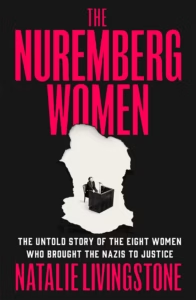
From The Nuremberg Women. Used with the permission of the publisher, St. Martin’s Press. Copyright © 2026 by Natalie Livingstone