Dusk fell in the shed, no wind, but the weather clearing. She split some logs, breathed in the scent. Hemp rope, oil, firewood and the clear evening visible through the gap in the south gable wall. The aperture was thin and focused, and through it she could see two woolly figures at the foot of the hill. The neighbour woman with her youngest, most likely, both kitted out in glowing headlamps and swaying softly as they rode at walking pace. Depending on which route they chose, they would be coming through her yard and northward on the old milk run, or they’d keep going straight at the bottom of the hill.
Article continues after advertisement
But here they came. They took their sweet time up the hill, and she stood putting logs into the basket as the headlamps danced like orbs above the fallow field in the growing dark. The mother on the bigger Icelandic at the back, the daughter at the front, but no longer small, thought Gunn. All things considered it was as though, in the year Gunn had been observing her, someone had grabbed hold of her at either end and yanked in both directions. She said as much as she went out into the yard to meet them:
– Look at you, sitting like a grown-up, Jenny, she said, which was disingenuous, because the girl was almost hanging there, and they halted, the horses’ winter coats steaming, mother and daughter, Brit and Jenny, in identical riding helmets with attached lamps.
– Happy New Year, Brit said, and they chatted a little about how the holidays had been, and: – Yes, she’s growing. If she carries on like this it won’t be long before we’re buying her a bigger horse.
The mother laughed, which made the girl slouched sullenly on her Icelandic glance back, and her mother brushed a hand over her face. She did that a lot, and every now and then a blush swept across her cheeks. Always happy, but that hand reaching for the mouth as though to stop what the mouth had already helplessly let slip.
– The weather’s calm, and the sky looks clear again, said Gunn. – Are you riding far?
They weren’t. In fact they were about to turn and ride back. But they’d seen the lights from the road and the mother had said, why don’t we ride up and see Gunn? So Jenny could ask her herself.
– Ask me what?
Gunn set the basket of firewood at her feet.
– She’s got this school project, the mother went on. – And Jenny really wanted to write about that black thingummy you’ve got hanging in your kitchen, what’s it called, you know, so that’s what we were thinking.
Something buzzed in Gunn’s pocket, a vibration against her thigh: a text. She took a swift glance, but no, it wasn’t from the satellite. It was from the boy, and in a moment it would buzz again.
– Which year are you in again? Is it eight or nine? she asked
– Anyway, they’re supposed to come up with a topic by them-selves, said Brit. – So we were thinking it might be fun, since we’ve got you next door. This one needs something interesting to get her teeth into, since she doesn’t fancy a year at boarding school like all the other kids her age.
Gunn waited for her pocket to buzz again, but no, don’t focus there right now, because the headlamps made mother and daughter look like cyclopses.
– Of course, Gunn said. – What did you have in mind?
It didn’t look like Jenny had anything much in mind, really, or perhaps it was the violent change her body was undergoing. When not dazzled by the lone eye, she could see the strange absence of identity in the girl’s face, and then came the pulse in her pocket again. A small jolt, and Gunn raised her hand, about to place it on the horse’s nose, but she must have moved too quickly; the animal made to rear up. But Jenny had it, no hesitation. No, no affectation there. She acted swiftly, instinctively, a beautiful common-sense reflex, and retained control.
– We can find a day for you to drop by. Does that sound good? she asked.
The girl nodded, and Brit finalised the details for her, coor-dinated and decided that it would be Saturday. Yes, Saturday, after Poul’s go-karting.
Well, that’s how it goes when you’ve got a dad who’s so handy with a screwdriver, eh Jenny? her mother said.
The girl shrugged. Gunn smiled. They took their leave and turned the winter-coated animals in the yard. A brief blinding flash of the headlamps in rotation, and then they moved away in the direction they had come. Swaying shapes, exerting a mutual pull on each other’s mass, a mother and a daughter, and as they passed the bare cherry-plum trees at the bottom of the garden, Gunn called out:
– I’ll be needing a haircut soon!
And the mother raised a hand and answered:
– Just give me a ring!
Then they continued down the hill toward the postbox, the whitebeam and the crosswise gravel path home. Which was a neatly tended place to the east, a proper family with a different order of gravity. A force such as that could make matter behave in peculiar ways, she knew, and took her phone out of her pocket. Opening the message from the boy, she paused with the firewood at her feet as the lights receded into the darkness:
Happy New Year. All good. 31° 51’ N, 91° 39’ W, he wrote.
He had sent a picture with it. A photo of his hand against a white-painted wooden wall. As though to document the validity of the information. If she got the urge to double-check the data.
It was what they had agreed: she would pay for his road trip, he would send her coordinates and visual documentation, and that was fine. He had to learn to orientate himself. It was part of being an adult, after all; she didn’t want responsibility for him anymore, and in any case it was impossible now. No, he had to learn to resist other people’s ideas, find his own way. Things had become destabilised in the civilisation he had left. But he’d find that out for himself sooner or later. A regular little Sergei Krikalev he was, energetic and gifted, that was for sure, and then she felt a surge of relief that he’d kept their agreement after all, sending the coordinates. The sight of his hand, the slightly crooked little finger. She had known that hand since it had belonged to a child. Dusted with chalk, but there was no mistaking it in the picture: he was a young man now, and a young man must be able to orientate himself. To stand on his own two feet, and she wasn’t going to check the coordinates. There had to be some sort of trust, and she stretched, because it felt good to stand like that. Up on her tiptoes, rising. Darkness settling now across the area. There were the sudden stars. Another centimetre more and she could touch them with her fingertips.
*
But she couldn’t just leave it, could she, the coordinates. No, she would solve his riddle that evening. Go slowly now, Gunn, she said to herself, bending over the basket of firewood. You can’t rush insight. It needs a systematic approach, ideally with a strong hypothesis. It’s about data. Data points are not thoughts in a stream to be stopped. They exist and can be read and understood once they are discovered, set down, documented and computed. Data to the decimal, yes, and there may not be enough of it to draw conclusions, but what data points have been established are factual and viable stepping stones to new knowledge. We must be bookkeepers: data can only be reliably interpreted if one doesn’t get carried away, and there was the handle of the bucket in her hand. There was one foot after another, through the kitchen and across to the stove. Put the bucket down, the kettle on. Socks, back to the living room, newspaper and briquettes. Pause until the fire is lit, and the kettle in the kitchen has long since clicked off. No rush, make the instant coffee and stir it less bitter with milk.
Only then did she sit down and write in her notebook:
Sunday. New Year’s greeting came in 16.21, photographic documentation. He also sent coordinates. Southern USA, estimated.
Patience. That was the basis of all research. That and curiosity, hard work and the ability to cope with disappointment, or at least to keep researching off the back of it. She had taught him that. The best thing that could happen to you was a paradox, a concatenation of discoveries, friction and collapsed assumptions: all new knowledge gives you the right to think, and a willingness to fail points you forward.
She had taught him that.
She lit a candle and fell back into her own thoughts, listening to the soft pursuits of night around the house. The fox perhaps, a deer or the rustle of the stone marten. Like electricity, it sounded, and somewhere to the northeast far away she could see a single tractor trundling back into the shed with a bucket full of feed. Out to the silage, home to the cows and the potatoes: Sava, Bintje, Folva, Estima. Boil them up just right, although Bintje was very mealy boiled, as she recalled. Sava, on the other hand, took boiling well. Gravy draped across it smooth as a quilt, and now she was hungry. There were maybe-maybe not potatoes in the pantry, and she glanced over at the door. On it was the poster of the black thingummy that had piqued Jenny’s interest.
Or was it Brit?
Yes, more likely Brit.
Which puzzled Gunn, because she couldn’t remember Brit ever asking her about work in all the time they’d been neighbours. Not when she cut her hair, or when they ran into each other in the system. Sometimes they’d drink coffee in the kitchen: no questions, just chatter about food and potted plants, and Gunn preferred to talk about the potted plants.
The biggest problem, when you don’t know anything, is asking the first question. Gunn knew that, and she also knew that was the blessing. But yes, it’s best to have something solid to seize hold of before you grope your way forwards. The end of a rope, fragments of a language at least, but no matter how much I alter mine, I still sound strange to Brit’s ears, thought Gunn. And I make her nervous. She might come across as uneducated, that’s why. Which she is, and yet I’m the one disrupting our shared understanding of reality.
But at least Brit was a good mother. Or so Gunn assumed, and a good mother is not to be scoffed at, even if good motherhood was sometimes tricky to deal with. Certain practical and loving people viewed abstractions as attempts to escape, and thus a way of failing at what was essential in life. Highly educated, sure, but what did Gunn know really? The really could not be measured and calculated mathematically. Instead you were supposed to make an effort with what was in front of you. Present yourself as the natural centre of a given family. Stuff your knowledge of placentas and sour nursing pads down strangers’ throats. It was natural, sacred almost, and preordained.
Spectroscopic surveys, on the other hand? No thank you, not while we’re eating.
And yet. On the pantry door hung an old poster of the dark hub at the centre of Messier 87. Millions of light-years away, but because of that black thing Brit had come riding up the hill at dusk. She had brought her daughter as a pretext. Other people’s children, thought Gunn, as she got to her feet and rummaged vainly for potatoes in the bucket behind the door. She found only a few wrinkled, inedible tubers already sprouting, and wrote ‘potatoes’ on a shopping list next to the spice shelf.
She boiled her spaghetti, ate it, with the black thing luminous just a few feet from the kitchen sink. Held up with tape at the corners in what the locals called Magna’s house, and which was now Gunn’s, although nobody really understood why.
It’s to do with the sky, she had informed the local paper when she moved in, but that didn’t change the fact that nobody really understood why.
*
Not until that evening did she type in the coordinates from the boy’s message, and it was as expected, although she’d never heard of the place before: Sicily Island, Louisiana. A one-horse town not far from the Mississippi River on its heaviest route south. A church, a high school, a supermarket. Not a single touristy photograph to be found on the web. The place had an opioid-ridden, dying look, and if he’d sent a similar picture to his parents they’d be standing in their open-plan kitchen right now gazing anxiously at each other. They would adjust the light above the kitchen island with that dimmer switch his father had installed, and they would agree to direct their anger towards Gunn. That was for sure. But he was getting on all right, the boy. She knew that, and there was no reason to lose sleep over what he was doing in that hole, and what would happen when he came home. If he did come home, and she typed.
Happy New Year. All good here. Static coordinates. Like you I’m in the back of beyond, I see. Remember to look up.
Should she send a picture as well?
No, no picture, and then she hit send. He wouldn’t reply, and she wouldn’t lose sleep over it. It wasn’t her responsibility, and still she lay sleepless when she went to bed.
It was partly the coordinates, partly the foot Brit had stuck in the door, and on top of that the gamma-ray bursts. She had taken these shifts so that her colleagues could enjoy the holiday with their families. Now the phone was on her pillow, in case there was a burst in the middle of the night. Anything that would be able to wake her if she dozed off was switched on, turned up. Above her, on the other side of the skylight she’d had put in, was a stretch of night sky. Over in the wide south-facing dormer window was the reflecting telescope. They’d been about to chuck it when they cleared out the teaching lab. But how big and beautiful it was. Pillar-box red and specially designed, and beyond it she could make out the lowermost stars in the Winter Hexagon. Betelgeuse and the Pleiades hung—one billowing, one trembling—out of sight somewhere past the window frame. Most of this had to be imagined from the bed, without the telescope, but she couldn’t be bothered to get up, and there was Rigel, if she felt like it, but she didn’t.
She thought of Sicily Island, Louisiana, and of course that couldn’t be seen even with the telescope. His hand against the white clapboard building, and how deeply she hoped he was activating his ability to orientate himself. In the meantime she was waiting for the next data set. From his trip, from the satellite, from the telescope, from Niels, from various students, from colleagues and from the deep universe. Yes, waiting for news with a faint heaviness in the body. It came and went and settled at the bottom of her, and she couldn’t sleep. Every time she tried to sink herself into sleep, she bobbed back up into consciousness again. Like a wobble-bottomed toy. Kept upright by all the things that might reach out and meddle: the will and ill-will of other people, their children and projects. And the gamma-ray bursts, and they were important. The smartphone against her thigh in her pocket by day. Close to her ear on the pillow by night. So that the satellite could get hold of her when the bursts came. That was how they did it, Merry Christmas. And no, she couldn’t sleep now, and so she looked up:
*
It was the same night sky she and everybody else had grown up underneath, with no notion of what exorbitant depths it contained. When she was a child, it was a black dome placed over the world each night, but behind that darkness was a light. Somebody had taken a cosmic needle and poked holes in the dome so that the light could filter in. These pinpricks constituted the stars, and when you’re little you’re allowed to imagine anything. It is an unheard-of privilege, and she had watched the Moon from the back seat of her father’s car. The way it always stayed still as he drove. It might disappear behind the trees, might be swallowed by the lighting in the streets, but the car kept driving on, and before long the Moon would pop up again. And again. Exactly where it was supposed to: waning, waxing, but constant, and now there she hung, just like the Moon, observing the expanse where she was trying to fall asleep.
It lay huge and dark, deep in the body of the landscape. At the periphery, the big cities with their golden nightlights bound together by long threads of motorway. Colonies of light, throngs of people, but there in the rural dark: an area whose infrastructure crumbled year on year. The geography was only for those in the know. Difficult to set out into, and at regular intervals people got disorientated and drove up gravel paths to places that no longer existed, or where the original track cut off. Long roads to dead ends, points where nobody passed through and which were suitable for hiding.
This is private property, the road ends here, and then the game cameras, the shooting stands, and she had found dilapidated camper vans abandoned in the depths. Small cabins with exotic names, but that far in the only visitors were accidental.
Orientating oneself meant knowledge of the road names and the ability to distinguish between a road where there were people living and a tractor trail. What looked like a through road on the map would often have transformed in the interim into a field. GPS didn’t work, coverage was patchy, and when it got so dark that if you were looking down from a satellite, as Gunn now drowsily imagined, the whole area would seem like some kind of crater.
But looking up from this dark hole, the night sky was a paradise of signs. Yes, seen from down in the crater, the sky was a piece of living archaeology, and the longer Gunn could spend gazing out at it, the better her grasp of the root of time. Burst by burst, flock of rooks by flock of rooks, and here I hang, she thought, tidally locked for the night, with my face turned to the earth like the Moon itself. I am somewhere in between them, hanging from a sewing thread, ready to fall or to rise.
What do I know?
What do I know that I don’t know? What would I like to know?
She repeated these questions so long that towards morning she was able to sink into a flickering sleep. Heart active as a baby bird’s. Ear turned towards the gamma-ray bursts from the pillow. Trying to crawl her way towards a spot between her shoulder blades. Scratch, scratch back, and no storm passed across the land. There was quiet and a new moon, black as soot outside, and far above the Earth, Betelgeuse was burning.
__________________________________
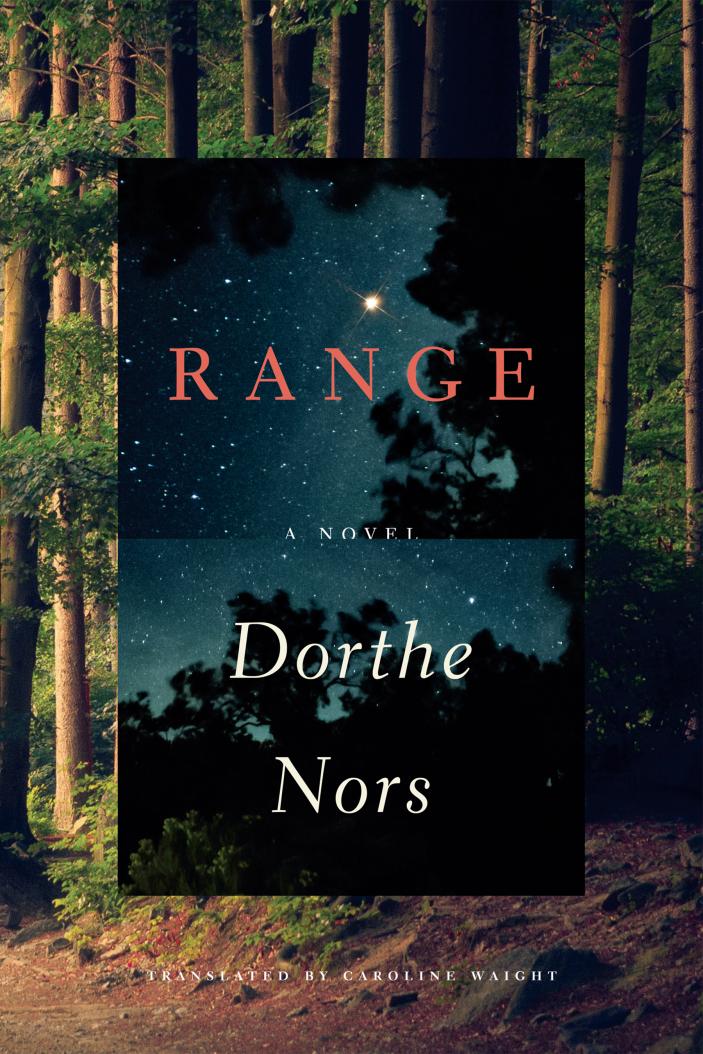
From Range by Dorthe Nors. Copyright © 2026 by Dorthe Nors. Reprinted with the permission of Graywolf Press, Minneapolis, Minnesota, www.graywolfpress.org.