
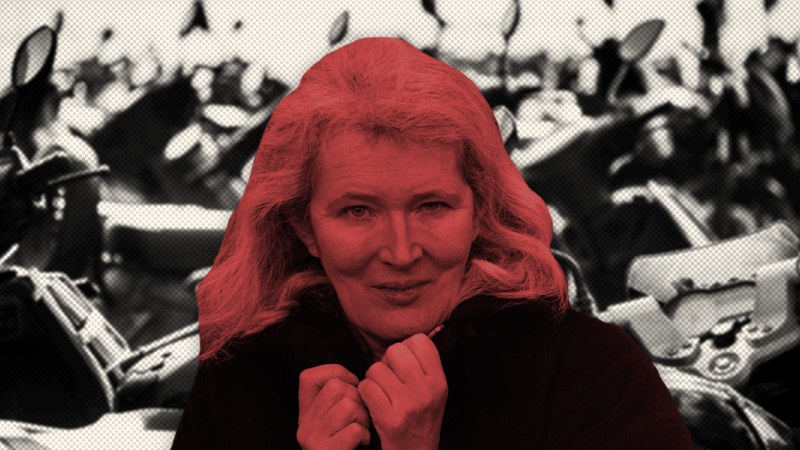
The Lit Hub girls are fighting!
Here’s a fun fact to celebrate Angela Carter’s birthday: the beloved feminist icon did not care for literary tote saint Joan Didion.
Need some proof? In 1986, Angela Carter sat down for a phone interview with Rosemary Carroll for BOMB. During the course of the interview, Carroll mentioned that she appreciated the “unique sense of real love for, and protectiveness towards, other women” in Carter’s work, adding: “It is something that I look for in women writers and almost never find.” Carter thanked her, and asked her what she meant. Here’s the resulting exchange:
RC
Women writers frequently adopt a tone or an attitude toward their female characters which is somewhat negative and ungenerous. It comes across as either whining self-indulgence or congratulatory, stolid self-reliance. There is so little compassion.
AC
To whom do you refer?
RC
Let’s say, Joan Didion, for example.
AC
Yah, boo, sucks. Although I am a card-carrying and committed feminist, what I would like to see happen to Joan Didion’s female characters is that a particularly hairy and repulsive chapter of Hells Angels descend upon their therapy group with a squeal of brakes and sweep these anorexic nutters behind them despite their squeaks of protest. Like a version, dare I say it, of the rape of the Sabine women. And bear them off to hard labour in the grease pits. Or else ten years compulsory re-education in the coffee plantations of Nicaragua might do the trick, make those girls feel there are worse things in life than running out of valium. Except what lousy fun it would be for the Angels. And the Nicaraguans might feel with justice it was a particularly foul CIA plot.
Actually, I think Joan Didion is an alien from another planet. Can we talk about a real novelist?
Yikes!* For a “real novelist,” Carroll suggested Doris Lessing, “a somewhat less obviously despicable example,” but Carter suggested that Lessing’s problem wasn’t with women, but with humanity: “Some people think life is worth living and others really don’t see the point of the whole thing. She is one of the latter—it is her entire view of the world.” In the end, they agreed on someone they did like: Jane Bowles. “She is wonderful, extraordinary,” Carter said. “But what a tragically sad end she met—it is, I suppose, a particularly poignant example of the terrifying fatality of being a woman.”
*For the record, here at Lit Hub, we love Angela Carter and Joan Didion and Doris Lessing and Jane Bowles. We also enjoy insults.