
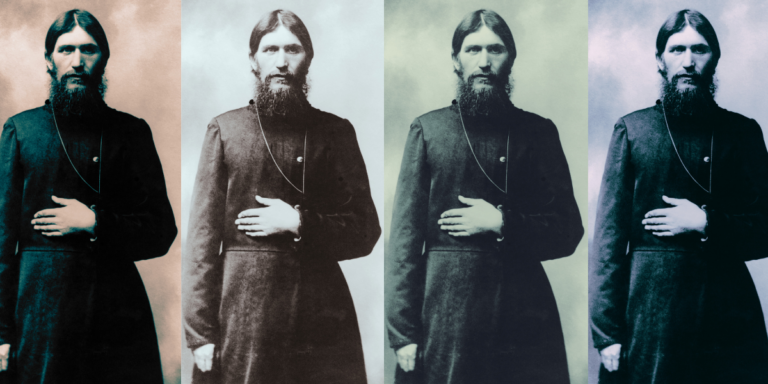
“This man was unique,” a famous Russian writer observed of Rasputin. “One of a kind, like a character out of a novel, he lived in legend, he died in legend, and his memory is cloaked in legend.” Nadezhda Lokhbiskaya, known by her nom de plume of ‘Teffi’ had the rare distinction of being read and enjoyed by both Tsar Nicholas II and Vladimir Ilich Lenin. She also happened to be one of the many women whom Rasputin attempted to seduce.
My fascination with Rasputin dates back a long way, even before I started researching my previous book Russia: Revolution and Civil War. How on earth could a barely literate peasant from Siberia have had such a devastating effect on the course of history? He had no official position. He had no forces at his command. He was a devoted monarchist, not a revolutionary. And yet, unintentionally, he contributed more than any other individual to the collapse of the greatest autocracy in the world. The poet Alexander Blok, who worked on the Extraordinary Commission examining the whole question just after the February Revolution of 1917, wrote:
Whoever this man was, the sphere of his influence was enormous. His days passed amidst the unique atmosphere of hysterical adoration and permanent hatred: some prayed to him, others sought to destroy him. The uniqueness of the lecherous moujik who was killed by a shot in the back at Yusupov’s “party with a gramophone” was above all due to the fact that the bullet that finished him off struck the very heart of the ruling dynasty.
Yet the striking image of that bullet destroying the Tsarist regime is far too simplistic. The mortal wounds were cumulative, and had already been inflicted.
The imperial officer corps was so demoralized by the exaggerated accounts of political and financial corruption, to say nothing of the totally untrue stories of Rasputin’s debauchery with the Empress and even her daughters, that when the February Revolution broke out in 1917 hardly a single sword was raised in defense of the Tsar. Seldom has the cause-and-effect chain of history been so influenced by a single man of humble origins and by wild rumors. Rasputin’s importance provides an intriguing difference angle on the so-called great man theory of history.
Seldom has the cause-and-effect chain of history been so influenced by a single man of humble origins and by wild rumors.
There is another aspect to what Teffi called ‘the legend’ which is equally intriguing. The myths and the lies which swirled around him were the fake news of their day. Rasputin himself was partly responsible for them through boasting of his connections with the imperial family. Yet the consequences reveal the phenomenon, all too often overlooked by historians, that rumor and conspiracy theories can produce even more powerful effects than reality.
*
In early 1914, Rasputin had moved to a new apartment at 64 Gorokhovaya Ulitsa. His life there, according to the over-loyal testimony of his daughter Maria, was utterly blameless. In her interrogation five years later she stated:
He never ate any meat to his dying day. His lunch always consisted of just fish soup…He always got up early and went to church. After that he would come home and drink tea with black dried bread or bagel. Supplicants would arrive immediately after the tea, and my father’s entire day would be spent on them…Everything that newspapers wrote about him after the revolution, about his lasciviousness, is a lie. He only knew one woman, my mother, and he loved no one but her.
Major-General Konstantin Globachev, the head of the Petrograd Okhrana responsible for Rasputin’s safety, did not share such an idealized image. “His most devoted followers were ladies who worshipped him and believed him to be a saint…Many had intimate relations with him, while others were still fighting for this honor. Their faith in Rasputin’s holiness was so great that they would kiss his dirty hands and receive food from them and obediently listen to his insults and rudeness and regard these a special treat.”
Rasputin’s tea parties for his devotees soon developed into a sort of salon. As a rule, he tended to attract slightly unbalanced or lonely women because he offered comfort for their unhappy souls.
His voice and his stroking caresses, accompanied by his ability to listen to their sad stories, could hardly have been more different from the cold disinterest of their husbands. Many remarked on his extraordinary powers of perception. He seemed to be the only man they had ever met who truly understood them.
One of his most devoted followers was Maria or ‘Munya’ Golovina, whom Felix Yusupov thought too innocent for her own good. At a moment of crisis in her life she had been standing in the Kazan Cathedral trying to pray in front of an icon. “Suddenly I heard someone reply to my thoughts. I turned and saw a pilgrim in a grey peasant coat. He bent towards me and said another few words. I realized that not only did he know everything that I was thinking, but also what had happened prior, and immediately I believed in him so much that my faith has never wavered.”
In St Petersburg’s aloof, overtly masculine society, empathy with women was indeed a rare talent. The ‘little ladies,’ as Rasputin called them, who flocked around him were regarded by their male peers as no better than nymphomaniacs, hysterics or thrill-seeking debauchees attracted to a peasant ruffian rather than to a gentleman of their own class. Olga Lokhtina was the most extreme example of a lost soul. Her crazed infatuation with Rasputin had a masochistic streak, almost deliberately provoking him. Vera Zhukovskaya, a newcomer to the salon, watched Lokhtina’s behavior in astonishment. She appeared wearing Rasputin’s wolf-skin cap with many colored ribbons attached to it. Underneath a goat-skin cape she wore several veils over a red shirt. On her belts she had hung little bags which contained items of half-eaten food and fish bones which she had saved from Rasputin’s plate as holy relics. She arrived singing in a high-pitched voice, “Christ is risen!” even though it was not Easter. She flung herself at Rasputin’s feet.
Rising from the floor, Lokhtina stretched her hands towards him. Rasputin, who was sullenly looking away from the moment she came in, turned to her, muttering: “All right, leave me alone, you Satan.” Lokhtina jumped up, hugged his head from behind and started kissing him madly, calling out some crazy, barely intelligible passionate names in a cracked voice. Rasputin was fighting back violently, shouting: “Satan, leave me alone! Devil, shit, satan! You bitch! Leave me alone!!”
He finally managed to tear her hands off his neck, and he threw her with all his force into the corner and then shouted, all red and disheveled, panting with fury: “You always manage to bring out the worst in a person, you devilish force! Bitch!”
Panting, Lokhtina crawled to the settee and collapsed next to it. Waving her arms that were covered with brightly colored veils, she shouted sonorously: “And still you are mine!! And I have venerated you!! And I have venerated you!…You are my God!”
Others at the table included the Tsaritsa’s devoted companion, Anna Vyrubova. Zhukovskaya described her as “plump and dressed in a too simple and even inelegant way. Her face was not pretty, with a bright-crimson sensual mouth and unnaturally bright big blue eyes.” Another present was Anna’s sister Alexandra, known as Sana, “a lovely blonde, refined like a Tanagra statuette with a tender face, and fine features.”
Rasputin would usually sit at the end of the table while his admirers leaned forward, eager to catch every word. He would let fall odd phrases or quotations from the Bible, adding his own observation in such an elliptical way that platitudes were made to sound Delphic and profound. Whether or not they understood, the women would nod sagely, sharing knowing smiles with each other, or exclaim in wonder at almost anything he said.
Vera Zhukovskaya had no illusions about Rasputin. She was a young graduate from Kiev who had come to Petrograd to study him and his famous powers. She had persuaded her uncle, Alexander Prugavin, an expert on Russian sectarianism, to accompany her on her first visit. Rasputin, although displeased to find she had arrived with a male relative, still tried to molest the young woman in front of him. Prugavin, while observing Rasputin, just managed to keep his temper while they were in the apartment. But once they were out in the street he started “walking with great strides and he sounded incensed.”
Prugavin thought that Rasputin was a criminal type, “a clever charlatan who had learned his art from some Siberian shaman, that he had a colossal force in him and used it with great skill.” He imagined that, as far as women were concerned, it was Rasputin’s crazy lasciviousness that played the decisive role. When they reached Zhukovskaya’s building, Prugavin stood for a long moment. “Do you remember his mysterious words about the Tsar?” he asked. “Mark them! Something is telling me that in them lies the explanation for this crazy phenomenon. Yes, I think that Rasputin is going to play a crucial role in the fate of Russia and of the dynasty.” Yet in spite of his diatribe against Rasputin, his niece Zhukovskaya was determined to see him again.
Although parts of her book should be treated with caution, other accounts confirm a number of key points. Most striking of all are Rasputin’s mercurial changes. General Globachev described how a very drunken Rasputin embraced him and kissed the top of his head. Yet as soon as he heard that the Palace had telephoned, he could exert such self-control that he instantly appeared totally sober. Globachev was impressed by this revelation of his “extraordinarily strong will.” The arrival of Anna Vyrubova had a similar effect, since Rasputin did not want the Empress to hear reports of his drinking. He regarded her as “a gramophone record he sent to the court,” since he knew she reported every detail to the Empress.
“With society ladies he tried to conceal his normal mode of behavior, especially in front of those with whom he did not have an intimate relation,” Globachev observed. Rasputin, for example, did not bother to conceal any bad behavior from Vyrubova’s sister Sana Pistolkors, with whom he may well have had a far more intimate relationship. “One could only marvel at the robustness of Rasputin’s constitution,” Globachev added. “After a drinking party he would go the banya and sleep for just two hours. Then, he was absolutely fresh and could start again.”
Several women also observed how Rasputin could switch from an almost uncontrollable lust to intense religiosity in no time at all. From pawing at his victim, he would suddenly go down on his knees and begin to pray in repentance. Many were fascinated by these contrasts and his controversial reputation. Others from less exalted backgrounds who lived nearby or in the same building had to deal with his drunken lust as best they could. One of the Okhrana agents even reported that “Rasputin brought a prostitute to his apartment and locked her up in a room; later in the day she was set free by the servant.”
Despite his impulsiveness and sudden changes of mood, Rasputin also had a transactional attitude with his grand ladies, almost as much as with his prostitutes, although it naturally required a good deal of flummery to veil it. These ladies hoped for help with petitions as well as sympathy; meanwhile he expected physical favors. As General Spiridovich put it, “the ladies who came to seek his protection often had to go into his little bedroom to pay the price.” If they refused he was sometimes angry and vengeful, but also forgiving if they showed spirit.
A number were encouraged to sacrifice themselves to help their husbands’ careers. A professor who made a study of Rasputin at the time interviewed one who had no regrets. She told him quite openly that “the first time the Starets possessed her she experienced such a powerful sensation that she fainted. Then, this violent impression turned into a ‘marvellous and delicious’ sensation that she had never felt before.” At least Rasputin did not take advantage from more sinister circumstances. An ambitious husband seeking promotion tried to force his beautiful young wife on him, as the writer Teffi described in her remarkable account.
Stepan Beletsky, when he returned to commanding the police as deputy minister of the interior, received daily reports on Rasputin’s behavior. He was rather less sympathetic towards him than in 1913, at the time of the plan to drown him in the Crimea, because he had become disgusted by the corruption which developed around him. Rasputin would pass him requests from women asking for sons or husbands to be excused military service at the front. “Then, how-ever, I realized that the number of such requests kept increasing and the kind of people that Rasputin was helping consisted entirely of wealthy people.” He soon became aware of what he called “Rasputin’s peculiar handling of lady supplicants,” especially the poorer and more vulnerable ones. This was a euphemism for blackmail and harassment up to and including outright rape.
Beletsky recounted the case of one poor woman who had spent almost all her savings to come to Petrograd hoping to save her husband from the army. “Rasputin made her an ultimatum: either to obey his demands and he would then ask the Sovereign to help her husband, or never show up again. Neither her tears, nor her pleas, nor the mentioning of her children helped. He took advantage of her nervous state and took her by force even though there were people in the room next door. He then visited her several times at the hotel, always reassuring her that the case was going to be resolved.” Beletsky’s police agents reported on numerous other incidents “when some of the women supplicants, mostly simple ones, would run out of this room in a disheveled state, swearing and spitting, but would be immediately hushed and removed from the apartment.” His hypocrisy was also flagrant. Rasputin, the self-styled voice-piece of the peasant and the poor, never dared to treat a woman of consequence in that way.
*
One morning, Nadezhda Lokhvitskaya, the real name of the writer Teffi, received a mysterious telephone call. She had been writing at her desk in a bay window. Her caller, whom she hardly knew, asked whether she had received an invitation from another acquaintance. Apparently afraid to mention anything on the telephone, he would not give any details. She called the acquaintance, but he too refused to say anything on the telephone. All he would offer was “the possibility of a very interesting meeting.” He then turned up at her apartment.
It transpired that the idea was for certain well-known writers and journalists to meet Rasputin at a dinner organized by his friend, the publisher Alexei Filippov. He was not to know who they were or what they did. The ubiquitous Ivan Manasevich-Manuilov, a rich networker who later became chief of staff to a prime minister, would also be there. Teffi considered him “one of those ‘companion fish’ that are part of the entourage of great writers or artistic figures.” The dinner with Rasputin would be on the following evening, but that night Teffi met a “mild-mannered lady, mousy and thin.” She suddenly confessed that “when [Rasputin] stares at me, my heart begins to pound in the most alarming way.”
The influential writer Lev Tikhomirov recorded a similar story.
A woman who had an urge to see Rasputin was immediately taken up to his bedroom and told to take her clothes off. When she pulled away, Rasputin told her to return at ten that evening, which even her husband could not stop her from doing. “She said that the eyes of the elder had had a striking effect on her.”
The next day Teffi noted that the hysteria around the name of Rasputin had made her “feel a kind of moral nausea.” She was not alone. In some dining rooms hostesses had even posted signs forbidding any mention of his name.
Teffi reached Filippov’s house soon after ten. She watched Rasputin closely. He seemed ill at ease. “Whenever he said something, he would look round the whole group, his eyes pricking each person in turn, as if to say, ‘Have I given you something to think about?’” She thought he was posturing and found the general atmosphere a mixture of tedium and tension.
Vasily Rozanov, the organizer of the evening, urged her quietly to engage Rasputin in conversation since she was an attractive woman and the Starets was a ‘ladies’ man.’ (So was Rozanov, a leading philosopher at the time. He maintained that political liberty in Russia could only come through free love.) He told her that she must turn the subject to the erotic. He clearly expected this to be easy, since everyone seemed to think that Rasputin was “at once a flagellant and a lustful satyr, both a saint and a man possessed by demons.”
The myths and the lies which swirled around him were the fake news of their day….Yet the consequences reveal…that rumor and conspiracy theories can produce even more powerful effects than reality.
At the dinner table, Teffi was seated next to Rasputin. He asked why she was not drinking. She explained that she did not like wine. Rasputin urged her again, saying that God would forgive her. On her other side, Rozanov asked her to get Rasputin to speak up so that he could hear what he was saying, and again he begged her to embark on erotic matters. Teffi retorted that she was not an agent provocateur, so why should she.
Rasputin, who kept on urging her to drink, slid a hand up to her shoulder. Teffi, a voluptuous woman of the world who had many admirers, was not surprised. “Evidently Grisha had a set routine. Raising my eyebrows in surprise, I glanced at him and smiled coolly.” Rasputin let out a quiet moan and angrily turned away. Yet a moment later he was back leaning in towards her. “You may be laughing,” he said, “but do you know what your eyes are saying? Your eyes are sad. Go on, you can tell me—is he making you suffer badly?”
Teffi started to find this ludicrous situation entertaining, with Rozanov on one side still complaining that he could not hear while Rasputin on the other tried hard to seduce her. He used every excuse to touch her, persuading her to take off her ring and let him breathe on it. He then urged her to visit him so that he could tell her many things she did not know. “But what if I don’t come?” she replied, taunting him. He touched her shoulder again, so she moved away. “Again, a spasm went through him, and he let out a low moan. Each time he sensed that his power, the current of his will, was not penetrating me and was meeting resistance, he experienced physical pain.” She even wondered whether there was not “a black beast howling inside him.”
Rozanov’s renewed whispering in her left ear clearly irritated Rasputin and he demanded to know what it was all about. Yet this interference broke up his attempt to persuade her to visit him, and someone else asked him if he wrote. Rasputin told one of his acolytes to distribute several typed sheets of his poems, which he happened to have brought with him. Teffi found them just a “jumble of words.” He tended to call everyone ‘Dearie,’ perhaps because he had trouble remembering names. He asked Teffi what hers was and then scribbled a message for her on a spare piece of paper: To Nadezhda. God is lov. Now lov. God wil forgiv yu. Grigory. Teffi studied the scrawl afterwards. She reflected with amazement how Rasputin’s notorious little notes could have such power, across government and society. And yet she could not help feeling that he was somehow adrift and out of his depth. Rasputin left abruptly after writing her that note, apparently summoned by a telephone call from the Alexander Palace, so another dinner was arranged shortly afterwards to make up for it.
This time, Teffi arrived to find Rasputin already at the table. He was wearing a pink taffeta shirt outside his trousers, with an embroidered collar buttoned at the side. Again seated next to him, Teffi was greeted with renewed promises that God would forgive her if she drank wine. He then murmured in her ear that he had missed her and had been pining for her. She dismissed that, and then, following Rozanov’s urgent prompting, asked Rasputin if he organized Khlyst rituals. Taken aback, he demanded nervously who had told her such a thing. He did not believe Teffi when she replied that she could not remember and changed the subject.
A friend of Rozanov blurted out a question about the Empress. Rasputin was not as put out as Teffi expected. He answered that she was not well at all. He would put a hand on her and pray, which made her feel better, but implied that her heart condition was incurable.
Rasputin switched back to his attempts to persuade Teffi to visit him. When she suggested that his other ladies would not like her there, he pounded the table with his fist.
“They wouldn’t dare! If I say, ‘Bathe my feet!’ they’ll do as I say and then drink the water. In my house everything is Godly. Obedience, grace, humility and love.”
“They bathe your feet. No, you’ll be better off without me.” “You shall come. I’ll send for you.”
“Has everyone really come when you’ve sent for them?” “No one’s refused yet.”
Teffi, realizing how drunk he was, lost interest until Rasputin suddenly revealed that he was quite aware that they were all writers. Teffi suspected that Manasevich-Manuilov had given the game away for his own reasons. She then wondered who out of all those round the table was most likely to be an Okhrana spy.
The musicians began to play. Rasputin sprang up, knocking his chair over in the process. He rushed off to dance in a frenzied fashion out of time with the music. Everyone still at the table watched in silent amazement. “How can anyone still doubt it?” Rozanov murmured to Teffi: “He’s a Khlyst!” Rasputin’s eyes were vacant and his mouth drooped open as he leaped around. Teffi could not face it any longer and set out to leave, ignoring Rozanov’s pleas for her to remain. He still longed for a journalistic scoop and was convinced that only Teffi had a hope of prompting a revelation.
As she fetched her coat, the music stopped suddenly. She found Rasputin barring her way. “I’m pining for you to come,” he pleaded. “I’m pining so badly I could throw myself down on the ground before you!” He let out a moan and started to shake. When she continued to refuse, he turned to a mixture of promise and threat. He might be only a peasant, but she should not turn up her nose. He could build stone palaces for those that he loved. Many people who did not understand him wanted to kill him as a sorcerer. “If they kill me, it will be the end of Russia.”
To Teffi he appeared utterly mad at that moment. “With his trembling hand crooked upwards, he looked like Chaliapin singing the role of the miller in Rusalka.” She was above all sickened by his behavior that created envy and sycophancy. “It was revolting and joyless.”
Rasputin still did not give up. He proceeded to use women under his sway as intermediaries to invite Teffi to parties where he would be. He then began telephoning. She suspected that he wanted her to write a flattering article about him and his ideas, exploiting her popularity with the public. Yet Teffi had no intention of ever seeing Rasputin again and she never did.
__________________________________

From Rasputin: The Downfall of the Romanovs by Antony Beevor. Copyright © 2026. Available from Viking Books, an imprint of Penguin Publishing Group, a division of Penguin Random House, LLC.