
Once Amy Poehler had committed to play Leslie Knope, the lead in Parks and Recreation, the producers began to gather inspirations in current culture that would prove crucial to shaping their vision. The media was touting that year, 2008, as “the year of the woman” in American politics. There had been a few previ-ous years of women—in 1984 with Geraldine Ferraro’s historic run as the first female candidate for vice president on a major‑party ticket, and 1992, when four women were elected to the Senate.
Article continues after advertisement
But in 2008, Clinton was a major contender for the Democratic nomination for president, though she lost to Obama. And Palin, a former midsize-town mayor, became the second female major‑party candidate for vice president. There were also many women running for the Senate and the House, including Susan Collins in Maine, Gabrielle Giffords in Arizona, and Elizabeth Dole in North Carolina.
Dole was the one current politico whom Daniels and Schur didn’t want Poehler’s character to emulate. “There was a kind of woman in politics at the time, and I suppose to some extent there still is, who is hyper‑polished, very stiff, like Elizabeth Dole was,” Schur says. “She doesn’t read as an authentic human being; she reads as a person who, if you want to be generous, you might say in order to survive had to take on a certain affect in a world obviously dominated, then and now, by men.”
For Schur, reading Infinite Jest had prompted an enlightenment moment.
Dole had just given a major speech at the 2008 Republican convention and became Daniels and Schur’s avatar of everything Poehler’s character would not be. Instead, they envisioned her as an optimistic workaholic who strives to improve her town, despite every possible bureaucratic impediment, and is often foiled. The character’s name would be Leslie Knope, her last name a knowing pun on the obstacles she would face.
Many other big ideas were circulating at the time that made their way into the DNA of the new show. The blockbuster book The Big Sort, by Bill Bishop with Robert G. Cushing, explained how Americans were increasingly moving into areas full of like‑minded individuals, resulting in polarization with groups who lived elsewhere and felt differently about political issues and values. Schur hoped to show how people of different political beliefs could live in the same community and, in fact, work together to make it better.
Schur also admired David Foster Wallace, the novelist and essayist best known for the encyclopedic novel Infinite Jest. He died by suicide at forty‑six in September 2008, as the show’s first script was being written. He, too, would inspire many ideas at the core of this new show.
For Schur, reading Infinite Jest had prompted an enlightenment moment. “It’s not a stretch to say that it’s influenced everything I’ve ever written,” he once said. “It kind of rescrambled my brain.” This happened when Schur was in college at Harvard, and he wrote his undergraduate thesis on the book. He also arranged for Wallace to receive an award from The Harvard Lampoon, which the author came to campus to accept. The two remained in touch afterward, and Schur, once he was established in Hollywood, bought the rights to adapt Infinite Jest. Nothing came of the adaptation, but Schur wrote a character named David Wallace into an Office script and later directed the video for the Decemberists’ “Calamity Song,” depicting Infinite Jest’s fictional game Eschaton.
In short, he was a fan.
At the time Schur was writing this new show, he remained so enamored of the 1,088‑page novel—about an über‑capitalist future where, for instance, each calendar year is sponsored by a corporation—that his wife banned him from discussing it at social gatherings. Wallace presents a singular vision, dystopian but funny, dense and smart, with details and footnotes upon footnotes that serve as serious nerd bait. “The creation of Leslie Knope would not have been possible,” Schur said, “without me reading David Foster Wallace.”
As Poehler was bidding farewell to SNL, Daniels and Schur were writing Obama’s message into their show.
Schur’s production would lean more utopian than dystopian but would be undergirded by this Wallace quote, which he kept on his of-fice wall for inspiration: “In dark times, the definition of good art would seem to be art that locates and applies CPR to those elements of what’s human and magical that still live and glow despite the times’ darkness.” Wallace’s dystopia had sprung from the cynicism he saw seeping into American culture. He showed that humor and sincerity could coexist, at a time when irony was the ultimate in cool. He did not see irony as harmless. He saw it as leading to his dystopia. Schur had the chance here to do the opposite, to create characters who could make the world better, who saw the point in doing so, who applied that CPR that Wallace spoke of.
Schur regarded his new show as a chance to do something he learned from Wallace: “I think TV has, at some level, trained people to believe that the only noble choice in life is to be the biggest, best, fastest, strongest,” Schur said in 2012. “One of the themes of this show is to celebrate the nobility of working really hard for your little tiny slice of America, and doing as well as you can for that part of it in a way that tangibly helps people.”
Daniels and Schur began to think about ways that their new show could “reflect back the vibe that we felt from the country, which was that the country was in desperate need of this kind of gritted‑teeth optimism,” according to Schur. By the time they were writing the pilot episode in earnest, the 2008 presidential election was dominating news cycles, and the electrifying Obama had everyone’s attention with his message of hope and change. As Poehler was bidding farewell to SNL, Daniels and Schur were writing Obama’s message into their show.
On a more obvious level, the new show was a response to one of Schur’s favorite TV series, The West Wing, the NBC political drama that had ended two years earlier. “The West Wing is federal, right? So it’s the stakes,” Schur says. “Every episode has enormous stakes. It’s global safety and security. It’s literally the West Wing, the center of all power in the world.” This show would be the opposite: just as political, but the smallest of stakes.
Daniels and Schur started on their script, drawing inspiration from all these books, events, and shows, along with the acclaimed HBO drama The Wire, with which they were obsessed during their time on The Office. (So much so that they tried to hire anyone they saw on the show. They succeeded in nabbing Idris Elba and Amy Ryan.) The pitch: What if we mashed up The Wire and The West Wing and Obama . . . but made it funny?
With this, NBC finally gave them the go‑ahead to make their show, even though it wasn’t an Office spin‑off. However, Ben Silverman would maintain, more than a decade later, that he still believed they should have made a true spin‑off. “They could have aired together back‑to‑back,” he told author Andy Greene for his book about the show, The Office. “This would be like the biggest thing. It would have been incredible. It was just shortsighted. Everyone would have loved it. It would have been better for both shows.”
Daniels valued research for his fictional projects. When he ran King of the Hill, he would take his writing staff to Texas every year, armed with reporters’ notebooks to interview locals and find story ideas related to the show’s setting. He also visited paper companies in Los Angeles, interviewing people with his “documentary crew” in tow, for The Office.
For the new show, he and Schur began to research local California politics, attending Los Angeles city council meetings to get a feel for their subject. They talked to government employees to inform their pilot script, including a city planner who said, “I’m a libertarian. I don’t really believe in government.” They couldn’t believe they had found a real‑life version of their libertarian character, the one who would serve as a foil to Poehler’s enthusiastic believer in the power of government. Forevermore, they’d have a rebuttal for skeptics who didn’t believe a libertarian would choose to work in government.
They still hadn’t picked a department for their characters to work in, but they wanted something “likable,” Daniels says. “And parks are just likable, right?” Daniels had also grown a bit weary of The Office’s indoor, fluorescent‑lit, beige world. “We did want to make it brighter and more optimistic and more colorful.”
They refined their vision for the fictional town. They wanted a town that had a Native American name, as so many US towns do. But the history of the town wouldn’t match up with any real American history. That avoided any comparisons to actual towns, but also, as Schur says, “That’s very American, to co‑opt something and then to not pay attention to the details of the history of what you’re engaging in.” Schur looked up Native American tribe names and noticed the Pawnee, who had become the namesake of several towns across the country.
Then again, maybe being in the news that much would cause problems. So Indiana it was.
The Pawnee tribe originated in Nebraska and northern Kansas, where they combined village living with seasonal hunting in a matrilineal political structure. In the 1820s, the Pawnee’s Petalesharo (Generous Chief) and Sharitahrish (Wicked Chief) visited President James Monroe at the White House as part of the federal government’s negotiations with major tribes; both men were painted by portrait artist Charles Bird King in a series of works meant to preserve, as Secretary of War James Barbour said, “the likenesses of some of the most distinguished among this extraordinary race of people” because “this race was about to become extinct.”
After years of wars with neighboring and encroaching tribes, and bouts with disease brought by white settlers, the Pawnee were forced to relocate to the Indian territory in Oklahoma, where they are still based. In 1906, the US government dissolved tribal governments, including the Pawnee’s, as Oklahoma prepared to become a state. They have about 3,500 enrolled members (as of 2019 statistics), who operate casinos, smoke shops, and a travel plaza, among other businesses.
Daniels and Schur placed their Pawnee in southern Indiana, Schur says, “because it was a place that no one knew anything about.” They considered Illinois but felt like Chicago was too much of a dominating force there. They thought about Michigan because it was in the news a lot at the time as both a swing state and the site of the auto industry bailouts. Then again, maybe being in the news that much would cause problems. So Indiana it was.
Their Pawnee, Indiana, would be no town and every town. Midsize towns across the country shared many similarities: Each has its gadflies, its oddball government officials, its operators, its antidevelopment granola types, its slick developers, its wacky religious cult, its local media celebrities, its rival snooty town. Eagleton, Pawnee’s haughty neighbor, “was based on the fact that there was a town next to my town called Simsbury,” Schur says. “And Simsbury was, like, one‑sixth the size. And everyone was rich and fancy. West Hartford had a real inferiority complex.” (And for the record, my Connecticut sources tell me West Hartford is the Eagleton to Hartford.)
Daniels and Schur began to draft a background document on Pawnee that would be for internal use and serve as a primer to future writers so that the town remained consistent. A kind of private Wikipedia page for the fictional place, it detailed statistics, demographics, and history. Among their first decisions was that Pawnee was smaller than Bloomington, Indiana—the home of Indiana University, which had about seventy thousand residents at the time—and, in fact, was smaller than the other well‑known cities in the state such as Muncie and Lafayette. Pawnee might rank as the sixth‑largest municipality in the state—not the biggest, not the smallest. Maybe around forty thousand people. “It is a medium‑sized town in a medium‑sized state in the middle of the country,” Schur concludes.
Pawnee, Indiana, was coming into its own.
__________________________________
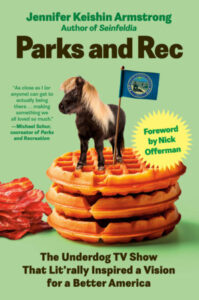
From Parks and Rec: The Underdog TV Show That Lit’rally Inspired a Vision for a Better America. Used with the permission of the publisher, Dutton. Copyright © 2026 by Jennifer Keishin Armstrong